
close
Choose Your Site
Global
Social Media


Views: 0 Author: Site Editor Publish Time: 2026-10-21 Origin: Site


Do thick clouds of reactive yellow dust routinely disrupt your plant's mineral recovery operations? For decades, froth flotation circuits have relied heavily on xanthates supplied in fine powder formulations. These chemicals are highly effective sulfide mineral collectors. However, powders frequently cause severe material handling bottlenecks. They lead to erratic dosing and create critical occupational safety hazards on the plant floor.
As metallurgical facilities modernize, a clear shift is occurring. Transitioning from traditional powders to engineered particle forms fundamentally resolves these operational pain points. In this comprehensive guide, procurement managers and metallurgists will discover exactly how upgrading reagent physical morphology directly improves storage stability, operator safety, and dosing precision.
Key Takeaways
Froth flotation remains the most critical physicochemical separation process in the global mineral processing industry. At the heart of this extraction method are xanthates. By selectively adsorbing onto the surface of target valuable minerals, they render these particles hydrophobic. The water-repellent minerals then attach to air bubbles introduced into the flotation cell, rising to the surface to form a mineral-rich froth that is easily skimmed and recovered.
Historically, the mining sector accepted the logistical and occupational health challenges of fine powder simply because it was the industry standard. The fine particulate nature of these chemicals resulted in significant material loss during transfer. It caused erratic feeding in automated systems and raised severe environmental health and safety concerns.
Recent industry analyses highlight a growing intersection between metallurgical efficiency and stringent environmental mandates. Modern mining operations face intense regulatory scrutiny regarding worker exposure limits and carbon disulfide emissions. Consequently, the paradigm is rapidly shifting away from volatile powders. Today's highly automated plants demand reagents that support continuous mass-flow systems rather than hinder them. This industry-wide push toward automation and zero-harm workplaces is the primary driver forcing facilities to rethink their reagent preparation strategies.
To address the inherent flaws of bulk powder handling, manufacturers developed specialized xanthate pellets and particles. These are created through precise extrusion or compaction manufacturing processes. The raw active chemical paste is mechanically pressed through sizing dies and subsequently dried under controlled thermal conditions. This transforms the amorphous, dusty powder into small, uniform cylindrical or spherical shapes, typically ranging from 2mm to 5mm in diameter.
Plant operators must understand that the internal chemical composition remains exactly the same. No artificial binders, fillers, or diluents are introduced during the extrusion process. The transition is purely a physical modification designed to optimize usability, flowability, and safety without altering the collector's metallurgical efficacy in the rougher or cleaner circuits.
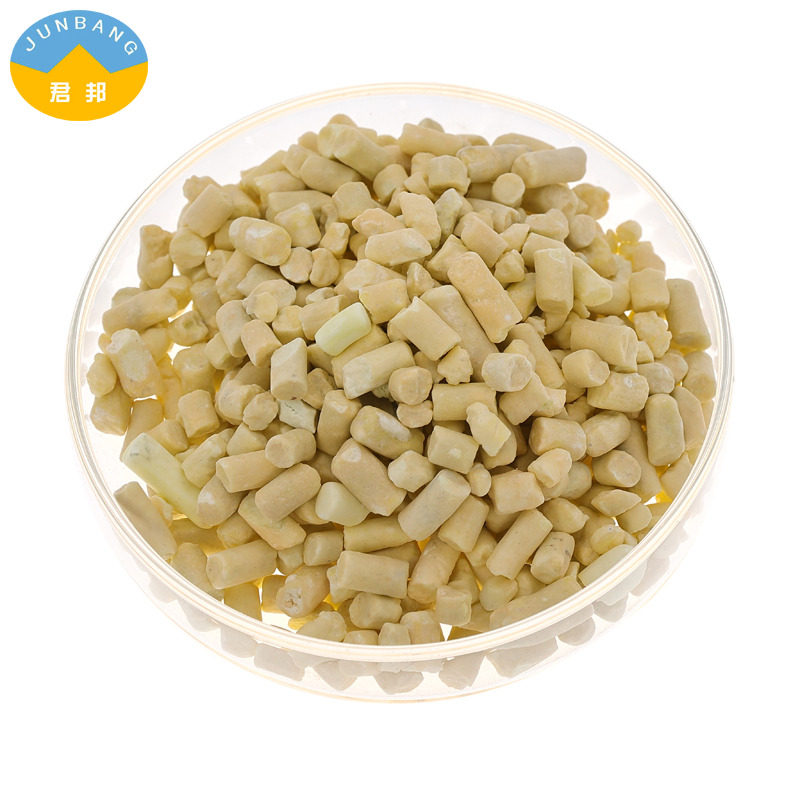
The distinction between the two forms is immediately apparent upon visual inspection. Traditional powder possesses a fine, flour-like consistency that is notoriously prone to clumping when exposed to even minor ambient humidity. The granular variant presents as a solid, uniform, and structurally robust material. This specific morphological difference is the root cause of the operational advantages observed in modern processing plants.
To clearly illustrate the impact on daily operations, the following table breaks down the core physical differences between the two formats:
| Feature | Traditional Powder Form | Engineered Particle Form |
|---|---|---|
| Surface Area | Extremely high, making it highly hygroscopic. | Low and compacted, resisting moisture ingress. |
| Dust Generation | Severe. Requires heavy PPE and specialized ventilation. | Virtually dust-free. Significantly improves operator safety. |
| Flowability | Poor. Frequently bridges and rat-holes in hoppers. | Excellent. Enables smooth mass-flow for automated dosing. |
| Dissolution Behavior | Prone to forming gummy lumps or "fish-eyes" in water. | Disperses evenly and dissolves completely with agitation. |
| Shelf Life Stability | Shorter. Degrades quickly in humid environments. | Extended. Maintains active chemical strength for 12+ months. |
The fundamental science driving this shift lies in the surface-area-to-volume ratio. Powders possess a massive cumulative surface area. In the context of industrial chemicals, a high surface area makes a substance highly hygroscopic. It acts like a sponge, readily pulling moisture from the surrounding air. Water acts as a catalyst for the hydrolysis and decomposition of these collectors, leading to a rapid loss of pulling power.
Compacted cylindrical geometries have a drastically reduced exposed surface area. This structural density makes them naturally resistant to humidity. The inner core of the pellet remains shielded from atmospheric moisture. This ensures the active chemical structure remains intact even during the humid summer months typical of tropical or coastal mining operations.
Storing bulk flotation chemicals requires strict adherence to environmental controls. Powders are notoriously difficult to warehouse safely. Due to their hygroscopic nature, they frequently suffer from severe caking if warehouse ventilation and climate are not perfectly controlled. Once a drum of powder cakes into a solid block, it becomes virtually unusable without hazardous manual intervention. Operators are often forced to physically break the chemical apart with hand tools, exposing themselves to immense risk.
Beyond the sheer operational inconvenience of caked material, the chemical volatility of degrading reagents poses a critical safety threat. When powders absorb moisture, they undergo a decomposition reaction that releases highly toxic carbon disulfide gas. This gas is extremely flammable and possesses a dangerously low auto-ignition temperature. If it accumulates in the headspace of a sealed drum or a poorly ventilated storage container, a simple static spark can trigger a catastrophic explosion.
The structural density of extruded forms minimizes moisture ingress, stifling the hydrolysis reaction. By preventing the rapid breakdown of the chemical, these forms drastically lower the rate of hazardous gas emission. This significantly mitigates the risk of spontaneous combustion in warehouses, providing plant managers with critical peace of mind and extending the viable shelf life of the inventory.
Accurate dosing of flotation collectors is a non-negotiable requirement for optimizing metallurgical recovery. In mineral processing, the line between maximizing valuable mineral extraction and wasting costly reagents is exceptionally thin. Over-dosing leads to poor selectivity, causing unwanted gangue minerals to float alongside the target metals. This ultimately lowers the final concentrate grade. Conversely, under-dosing leaves valuable minerals in the tailings dam. Achieving the exact required dosage relies heavily on the physical properties of the chemical being fed into the system.
Modern flotation plants increasingly rely on automated dosing systems to maintain steady-state operations. However, traditional powders exhibit poor flowability due to strong cohesive forces between the fine particles. In standard hoppers and screw feeders, powders tend to form a stable arch over the discharge outlet or create a narrow vertical channel while the surrounding material remains stagnant. This results in erratic feeding that forces operators to manually hammer the sides of the hoppers to restore flow.
Granular shapes achieve consistent mass flow through automated gravimetric and volumetric feeding systems. They ensure the exact required mass of chemical is delivered to the mixing tanks every minute. This reliability eliminates equipment blockages and stabilizes the entire flotation circuit.
Furthermore, solving the dissolution bottleneck is a major operational win. A common misconception is that powders are superior because their high surface area allows for instant dissolution. In reality, when large volumes of powder are dumped into a mixing tank, the outside of the powder mass hydrates immediately. This forms a gelatinous, impermeable barrier around the dry powder inside. These "fish-eyes" can take hours to dissolve and often blind dosing pumps. Engineered shapes drop cleanly into the mixing water and disperse evenly before dissolving rapidly under standard mechanical agitation.
Transitioning away from powders requires selecting the right active chemical for your specific mineralogy. By utilizing high-purity granular forms, metallurgists can lock in consistent recovery rates. Here is how to approach the selection based on real-world engineering parameters.
Sodium Isobutyl Xanthate is widely recognized as the workhorse reagent for base metal operations worldwide. Featuring a four-carbon alkyl chain, it provides an optimal balance between strong collecting power and acceptable mineral selectivity. When evaluating sodium isobutyl xanthate particle options, engineers should look for strict quality parameters. High-grade variants typically guarantee an active substance purity of 90% or higher, with free alkali limited to under 0.2% and moisture content strictly controlled below 4%. The standard 2mm to 5mm pellet size ensures these parameters remain stable during long ocean freight transits. This specific collector is ideal for copper ores, particularly those containing chalcopyrite, where fast flotation kinetics are required to maximize throughput in the rougher circuit.
When standard collectors fail to achieve desired recovery rates due to complex mineralogies, metallurgists turn to heavy-duty options. With a five-carbon alkyl chain, Sodium Isoamyl Xanthate is one of the most aggressive collectors commercially available. It is typically reserved for difficult-to-float ores, heavily tarnished sulfides, and complex polymetallic deposits. Because it is a more chemically aggressive molecule, it is inherently more prone to rapid decomposition if exposed to moisture in powder form. By utilizing a high-purity sodium isoamyl xanthate particle, plants can harness intense collecting power while actively suppressing the generation of hazardous dust. The compacted structure locks the volatile C5 chain safely inside, keeping the active purity high and the moisture content low until the moment it hits the mixing tank.
Procurement teams evaluating flotation reagents often focus solely on the initial price per metric ton. However, executing a Total Cost of Ownership analysis reveals that the cheapest chemical upfront is rarely the most cost-effective solution. The physical form of the reagent heavily influences hidden operational expenses.
Conclusion
While powder formulations served as the traditional standard for decades, the operational, safety, and economic advantages of engineered particles make them the superior choice for modern mineral processing plants. By significantly reducing hazardous dust generation, improving shelf-life stability, and enabling precise automated dosing, these advanced physical forms directly address the most pressing challenges in the reagent preparation area.
Plant managers and metallurgists should carefully evaluate their current dosing systems, storage conditions, and safety records. Switching physical forms can optimize daily flotation circuits, protect your workforce, and lower your total cost of ownership. If you are ready to eliminate dust and improve dosing accuracy, visit Junbang Chemical to explore high-purity collector specifications and request technical samples for your next lab-scale flotation test.
While an individual speck of powder dissolves almost instantaneously due to its high surface area, bulk powder often forms gummy lumps when dumped into water. This actually slows down the overall batch mixing process. High-quality extruded variants are specifically formulated for rapid, uniform dispersion. In standard industrial mixing tanks with proper mechanical agitation, they dissolve steadily without clumping. The difference in total batch dissolution time is negligible and does not slow down plant operations.
In the vast majority of cases, yes. In fact, these granular materials typically flow much better through standard screw feeders, rotary valves, and hoppers than powders. Because the bulk density and flow characteristics differ from aerated powder, minor calibration of your automated feed rate will be required to ensure precise gravimetric or volumetric dosing.
They must be stored in a cool, dry, and well-ventilated warehouse. They should be kept strictly away from direct sunlight, open flames, heat sources, and moisture. While the compacted form is naturally more stable and resistant to humidity than powder, standard chemical storage protocols must still be rigorously followed to prevent slow degradation and the subsequent release of hazardous gases.
Yes, they are significantly safer. The primary occupational safety advantage is the drastic reduction of airborne chemical dust during handling, pouring, and mixing. This practically eliminates inhalation risks, reduces the likelihood of severe skin and eye irritation, and drastically lowers the risk of explosive dust accumulations forming in enclosed reagent preparation spaces.
The physical form itself does not alter the fundamental chemistry of the collector. However, it indirectly improves recovery rates by ensuring dosing consistency. Because powders frequently bridge in hoppers, plants often experience micro-fluctuations in reagent feed rates, leading to temporary under-dosing. The reliable mass-flow of granular forms ensures a perfectly steady concentration in the flotation cells, stabilizing the froth and maximizing continuous recovery.
When stored correctly in original, sealed packaging within a climate-controlled environment, high-quality extruded pellets can maintain their active chemical strength for 12 months or more. This is a significant improvement over traditional powders, which often show severe efficacy loss and caking within three to six months if exposed to ambient plant humidity.

